World and Context
The Quickstart campaign is set in the Tear campaign universe which is decribed in detail in the World Guide.
Because the purpose of the Quickstart campaign is to get you playing quickly, the relevant information you might need about the world is included here, and links to the more detailed information in the World Guide are provided throughout the adventure.
Cosutanu
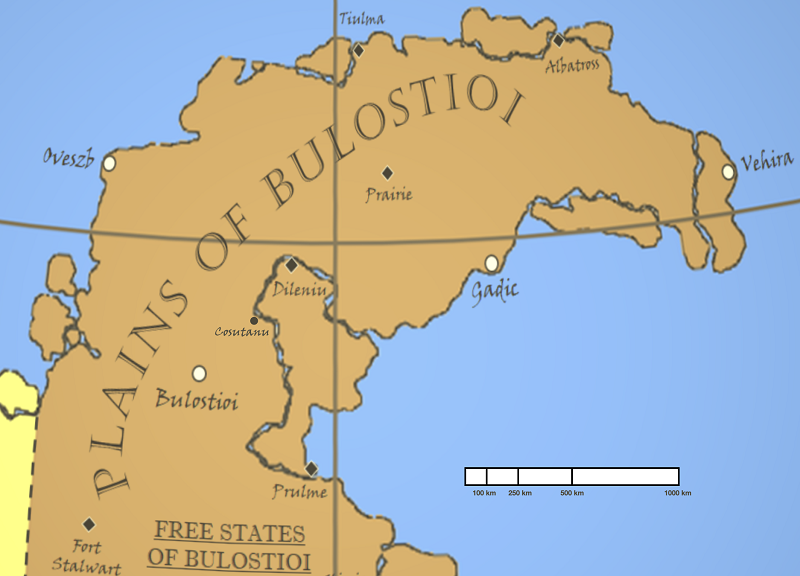
The campaign takes place in the village of Cosutanu which lies about 350 km northeast of the city of Bulostioi, making it the northeastern-most holding of that city state and marking the last stop on the road that crosses the Prulme River into the territory of the smaller, neighbouring city state of Dileniu which lies about 300 km further northeast.
The Plains of Bulostioi
Cosutanu is centrally located in the Plains of Bulostioi region which stretches over 4000 km from central Tulosz to the eastern tip of the continent at Vehira. This is the breadbasket of eastern Tulosz, and the bountiful and stable food supply has afforded continual growth, development and relative peace for generations.
This region is a massive temperate prairie grassland, with rolling hills, green pastures, and expansive forests in all directions. The towns and villages here produce grains, fresh fruits and vegetables, meats and cheeses, and a range of hardwoods and softwoods. Iron, copper, silver, sulphur, and coal are mined here, and there are a few diamond and emerald mines in some of the more remote areas.
The Free States of Bulostioi
Politically, Cosutanu is a holding of the large and powerful city state of Bulostioi, which is among the more powerful city states in political region known as the Free States of Bulostioi which never reformed into a centralized nation following the collapsed of the Kingdom of Tulosz in 1185 - 238 years before the current date.
Currently, the region is unofficially united into an ad hoc league of city states that share economic, social, cultural, and political commonalities. People here generally have a strong anti-imperialist sentiment, and Unionist religious leanings.
Tulosz
Tulosz is one of the larger continents on Tear. Roughly half of the contintent (including the half where the Plains of Bulostioi are) is located in the Vehiran hemisphere, meaning Vehira (the planet) is always visible in the sky. In the western half of Tulosz, Vehira is never visible in the sky.
For much of recorded history, Tulosz was home to a collection of largely autonomous city states. Toward the end of the Orcish Conquests of the Third Epoch (and largely as a reaction to them), most of the city states of Tulosz formed into the Kingdom of Tulosz, which lasted through the end of the Third Epoch and into the Fourth Epoch, continuing for seven hundred more years until it collapsed due to insolvency in 1185.
Tear
The world of Tear, on which Tulosz is located, is one of six moons that orbits a planet known as Vehira. Vehira is a medium sized gas giant orbiting within the habitable zone of its star, Azane. The other five moons that orbit Vehira are Xiophoene, Lisaea, Obrum, Iodrux, and Alcinette. All of these celestial bodies (and their darker aspects Lobok, Golmongarion, Scilisanthes, Uleila, and Sixthos) are represented as deities in the major religions of Tear.
Culture
The principal language spoken in Cosutanu and across most of Tulosz is Tuloszian, though the trade language of Comerta is extremely common, particularly along the Prulme and along trade routes between cities. Senecian is also spoken by some, particularly those coming from the region of Prulme.
For centuries, half of Tulosz developed a religious tradition centered around Vehira (the Vehirist tradition) while the other half developed a different but related religious tradition whose adherents had never even seen Vehira (the Azanists).
Eventually, because the presence of a planet in the sky is an irrefutable fact, these two religious traditions were ultimately forced to reconcile with one another. The result was a new religious tradition known as Unionism. While there are several major religious traditions on tear, the Unionist religions are the most common. Unionist religions hold Vehira and Azane to be co-equal Creators, and hold the Siblings (represented by the other moons of Vehira) and the Versai (the darker aspects of the Siblings) to be lesser divinities; the children of Vehira and Azane.
Together this familial pantheon of Celestials stand as bulwarks against the dark forces of the Infernals - sinister deities who seek only destruction, suffering, chaos and torment.
Time
The Quickstart campaign takes place in middle of the Fourth Epoch, in a period known as the Enlightment. It is springtime of the year 1423, almost 250 years after the collapse of the Kingdom of Tulosz. The city states of Bulostioi and Dileniu, along with several regional socioeconomic powers have managed to maintain relative peace across the Plains of Bulostioi for over a century.
The campaign begins on the 17th Day of the Trowel. For reference, this is the fourth month, and it follows the month of the Bucket. There are ten months in the Tear calendar, all of which have 40 days, and each day is 24 hours long.
Because neither Vehira nor Tear have a significant axial tilt, dawn and dusk everywhere on Tear are at 6am and 6pm every day - with the hour before and the hour after representing periods of twilight. At the longitude of Cosutanu Vehira is always visible in the sky at about 27 degrees over the horizon to the east. Here, reflected light from Azane keeps the night sky comparatively bright; just bright enough to read with the naked eye by the light reflected from the planet, while shadows remain dark enough to hide in.
In Cosutanu at 7:45am each day, Vehira eclipses Azane for 80 minutes, until 9:05am. This period is called the Ora Concepci and it is the darkest time of the day (much darker than night time). During this time, work stops and people retreat indoors to take a full meal and a rest (the day usually starts with a light snack and tea at 5:30am, and work begins at 6am.