Trapped Stairwell
Leading down from the Entry Chamber is a narrow stairwell, less than 2 meters wide. Here there are no pilasters and no plaster sections, and the stone walls and steps are hewn smooth. The stairway descends some twenty meters down, on a steep 45 degree angle. Halfway down is a small landing with a passage off to the side leading to a large, empty room of 4 meters by 7 meters. The purpose of the room is unclear, and it is one of the few rooms in the tomb that does not feature regular pilasters with plaster murals between them.
TRAP: the stairs of death
The stairwell is a very dangerous trap. The Director should take the time to read the description of the trap carefully to be sure they understand it. This trap can easily kill multiple characters if not navigated properly. Triggering the trap will transform the stairs into a dangerous, slippery slope with blades at the bottom, and only very specific actions can prevent this.
Trap Elements
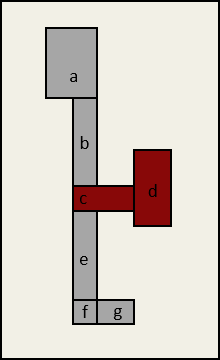
The trap has four states: Enabled, Disabled, Suspended and Triggered. The trap begins in the Disabled state, and if it ever enters the Triggered state, it cannot be reset. The states of the trap are toggled by two pressure plates; one on the Middle Landing, halfway down the stairwell and one in the Side Chamber off of the Middle Landing.
Middle Landing Pressure Plate
Stepping on the Middle Landing (c) will toggle the trap between its Enabled and Disabled states unless it is currently Suspended. The trap starts in the Disabled state, so the first person to reach the landing will Enable the trap.
Side Chamber Pressure Plate
Stepping on the floor in the Side Chamber (d) will Suspend the trap for as long as someone (or something weighing 50 kg or more) remains on it, preventing the state from changing and preventing the trap from Triggering. Stepping off of the pressure plate un-Suspends the trap.
Disabled State
The trap starts in the Disabled state. While in the Disabled state the stairs (b) and (e) can be walked on without Triggering the trap. Stepping on the Middle Landing (c) will put the trap in the Enabled state unless the trap is currently Suspended.
Enabled State
While in the Enabled State, walking one the stairs (b) or (e) will Trigger the trap. Stepping on the Middle Landing (c) will put the trap in the Disabled state unless the trap is currently Suspended.
Suspended State
While in the Suspended state the stairs (b) and (e) can be walked on without Triggering the trap. Stepping on the Middle Landing (c) will not change the current state from Enabled to Disabled or vice versa.
Triggered State
If at any time the trap is in the Enabled state but not Suspended (ie: no one is standing in the Side Chamber (d)), the trap will be Triggered. Once Triggered, the trap can never be deactivated, suspended, disabled or re-enabled.
When Triggered, the forward lip of each stair above (b) and below (e) the Middle Landing (c) will sink, causing the twin stairwells to form two long, steep 45 degree stone slides. As the stairs sink to their new angle they will crush jars filled with mineral oil long concealed beneath them, lubricating the smooth slope created by the stairs.
At the bottom of the stairs, the action of the trap also causes dozens of long iron blades to slide out of the wall at the base of the stairs (f).
Triggering the Trap
Anyone on the stairs (b) or (e) when the trap is Triggered will need to roll a 21C using Agility (-5) to avoid starting to slide down. Even if they succeed, they will need to make this roll every turn. Success will allow them to move 1 hex up or down. Failure means they slide with no hope of recovery until they hit bottom. Worse still, anyone they hit on the way down is at an additional -5 on their roll, with the penalty accumulating for each person sliding.
The lowest person on the stairs will slide down to the bottom and become impaled on the extended blades, taking 4d6 points of damage, plus an additional 1d6 for each person sliding down behind them.
The second person will take 2d6 points of damage, plus an additional 1d3 for each person sliding down behind them, and the third person will take 1d6 plus an additional 1d2 for each person sliding down behind them. Everyone after the third person only takes 1d2 plus 1d2 for each person who slams into them.
Note: if the trap is ever Triggered, the entire stairwell will remain a steep, 45 degree slope, covered in mineral oil, with sharp blades waiting at the bottom for anyone who slips. The slope will remain incredibly slippery for months. Ascending the slope will require ingenuity, a lot of time, and likely many skill rolls - and failures can result in sliding back down into the blades. It is essentially impossible to flee up the lubricated slope quickly if attempting to escape pursuing enemies from further below.
Trap Flow
The players start in the Entry Chamber at the top of the stairs (a). The trap begins in the Disabled state. The players can walk safely on the stairs (b). As soon as someone steps on the Middle Landing (c) however, the trap is Enabled.
CHALLENGE
21C using Alertness (-3) or by intentional use of the Traps skillAnyone who steps on the Middle Landing (c) may notice that something moved very sightly. This is the action of the pressure plate that Enables the trap.
If at this point anyone is on the stairs (b) or (e), the trap Triggers.
If no one is on the stairs, but the the player continues onward from the Middle Landing (c) without someone standing in the Side Chamber (d), the trap Triggers. The only option is for the player who reaches the Middle Landing to go into the Side Chamber and stand on the pressure plate to Suspend the trap.
CHALLENGE
21C using Alertness (-3) or by intentional use of the Traps skillAnyone who steps into the Side Chamber (d) may notice that something moved very sightly. This is the action of the pressure plate that Suspends the trap.
With the trap Enabled, but Suspended, it is safe to walk on the stairs (b) and (e). Any or all of the remaining players can proceed all the way to the bottom to safety in the corridor (g) that that leads to the Mural Chamber. Stepping on the Middle Landing (c) will do nothing while the trap is Suspended.
Once everyone (from 0 to n persons) has passed, the character in the Side Chamber (d) can leave it, un-Suspending the trap, and returning to the Middle Landing (c), thereby Disabling the trap. They can then proceed all the way to safety (g).
If the trap is exitted safely in this manner, it will be left in the Disabled state, and the players can safely navigate out using same method in reverse.
Detecting and Bypassing the Trap
Hopefully the players will be cautious upon first entering the Tomb, and will take the time to check for traps. If so, because of its size and complexity, survivingit is not simply a matter of detecting it. To be told how to get past the trap, the characters will need to detect each of its major elements, then determine what is does, and then from there they can determine how it works in order to bypass it safely.
Of course, nothing prevents them from just going forward blindly, or from trying to navigate the trap after detecting it, but without figuring out how it works. If this happens, the director should keep careful track of the states of the trap as players move around.
CHALLENGE
21C using Detect Traps SpellAnyone who uses the Detect Traps Spell will be able to discern that any of the elements of the trap they can see (the stairs (b) and (e), the Middle Landing (c), the Side Chamber (d), and the bottom wall (f)) are all part of a large, elaborate trap. The spell will not reveal what the trap does or how it works.
CHALLENGE
21C using Traps SkillAnyone who uses the Traps Skill to detect the trap will need to be close enough to inspect each element (the stairs (b) and (e), the Middle Landing (c), the Side Chamber (d), and the bottom wall (f)) in order to detect it and gain a complete picture of the trap. Detecting the trap in this way will not reveal what the trap does or how it works..
CHALLENGE
21C using Traps Skill (-2)Once the three elements of the trap that matter to its operation (the stairs (b) and (e), the Middle Landing (c), the Side Chamber (d)) have all been detected, a successful 21C using the Traps Skill at -2 will reveal what the trap does. Once Triggered, the stairs will collapse into a slope and that mineral oil will spill out making them very slippery. If the person making this roll has also been able make a visual or tactile inspection of the bottom wall, they will also understand that blades will come out of the wall when the trap is Triggered.
CHALLENGE
Versus Challenge to bypass the Trap (26)Once the three elements of the trap that matter to its operation (the stairs (b) and (e), the Middle Landing (c), the Side Chamber (d)) have all been detected, and a roll has been made to figure out what the trap will do once triggered, only then can a Versus Challenge using Traps Skill be made to figure out how to bypass it safely. If this roll is made, the Director can explain how to avoid the trap. Note that nothing but trial and error can tell the players how much dead weight is required in the Side Chamber to permanently Suspend the trap. Piling up 2-3 ghoul corpses will do the job, but dropping backpacks and extra gear probably won't be enough.
CHALLENGE
21 Challenge using Agility to leap across the Middle LandingIf the trap is figured out early, the simplest, fastest (and most reckless) way to bypass it is to simply leap across the Middle Landing. This is not far, but it is tricky, as the ceiling is low, and the landing is on stairs going down. If you fail, your legs will slip out from under you and you will fall back onto the Middle Landing, putting you on both the stairs and on the Middle Landing - which Triggers the trap.